
At the May Governing Board meeting, the Board received an update on progress toward achieving Academic Goal #4 and interim goals 4.1 and 4.2.
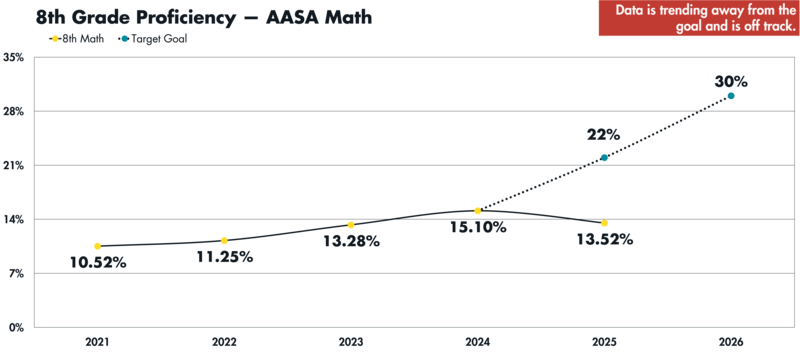
Eighth Grade AASA Math Proficiency
Academic Goal #4
The percent of fifth-grade students who score at Proficiency or higher on AASA Math will increase from 12% in Aug. 2023 to 45% by Aug. 2028.
Data is trending away from the goal and is off track.
Sixth through eighth-grade math is at 12% proficiency according to STAR Math results. This data, in addition to AASA 2025 data, provides evidence that goal 4 is the furthest from being on track and will require the greatest change in proficiency scores to achieve 45% proficiency by 2028.
Sixth Grade STAR Math Proficiency
August to March Progress Monitoring (Full Academic Year Only) By School
School | Students | Minimally | Percent | Partially | Combined | Percent |
|---|---|---|---|---|---|---|
Bernard Black | 57 | 80.7% | ↑ 10.5 | 7.0% | 12.3% | ↑ 1.7 |
C.O. Greenfield | 93 | 57% | ↓ 12.9 | 21.5% | 21.6% | ↑ 8.7 |
C.C. Campbell | 58 | 55.2% | ↓ 5.1 | 15.1% | 29.3% | ↓ 1.7 |
C.E. Chavez | 42 | 78.6% | 0.0 | 19.0% | 2.4% | ↓ 9.5 |
E.V. Pastor | 62 | 67.7% | ↓ 1.7 | 22.6% | 9.7% | ↑ 3.3 |
Ignacio Conchos | 60 | 63.3% | ↓ 6.7 | 16.7% | 20.0% | ↑ 3.3 |
Irene Lopez | 64 | 71.9% | ↓ 1.5 | 10.9% | 17.1% | ↑ 1.5 |
P.L. Julian | 37 | 59.5% | ↓ 5.4 | 16.2% | 24.3% | ↑ 8.1 |
Southwest | 44 | 75.0% | ↓ 9.1 | 15.9% | 9.1% | ↓ 2.3 |
Sunland | 101 | 81.2% | 0.0 | 12.9% | 6.0% | 0.0 |
T.G. Barr | 33 | 75.8% | ↓ 6.0 | 9.1% | 15.2% | ↑ 9.1 |
Valley View | 62 | 64.5% | ↑ 1.6 | 24.2% | 11.3% | ↓ 3.2 |
District | 713 | 69.0% | ↓ 3.1 | 16.3% | 14.7% | ↑ 1.7 |
Interim Goal #4.1
The percentage of students performing at Proficiency or Higher on the sixth-grade STAR Math Assessment will increase from 19.7% to 28% by May 2026.
This interim goal is trending correctly, but off track.
At the start of the school year, sixth-grade students were performing at 12.6% proficiency on the assessment. At the time of the January benchmark testing, they were performing at 12.1% proficiency, and are not currently expected to achieve the 28% goal set for May 2026.
Interim Goal #4.2
The percentage of students performing at minimally proficient on the sixth-grade STAR Math Assessment will decrease from 64.3% to 49% by May 2026.
This interim goal is trending correctly, but off track.
At the start of the school year, sixth-grade students were performing at 73% minimal proficiency on the assessment. At the time of the January benchmark testing, they were performing at 71.2% minimal proficiency, and are not currently expected to achieve the 49% goal set for May 2026.
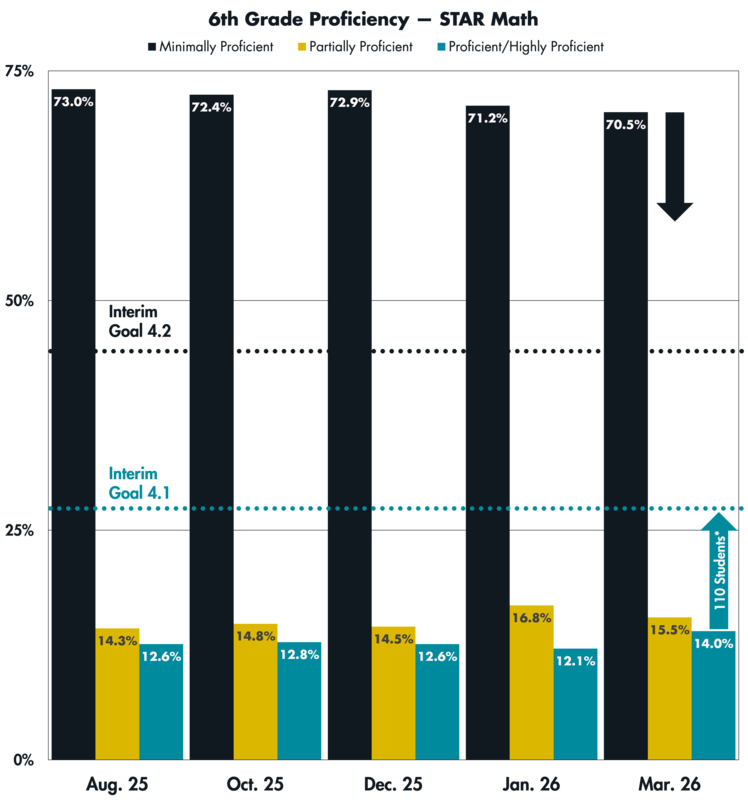
The teal arrow indicates our interim goal of reducing minimally proficient students to below the teal dotted line, and the black arrow indicates increasing proficient students to above the black dotted line.
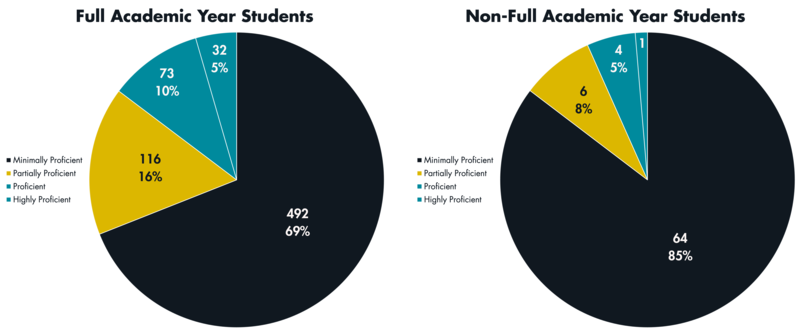
Full Academic Year Comparison
Key Inputs
Targeted Tutoring Outcomes
Students Receiving Tutoring
Grade | Students | Dec. Avg. Scale Score | Mar. Avg. Scale Score | Tutoring Change | Dec. Proficiency | Mar. Proficiency | Proficiency Change | Count of Change |
|---|---|---|---|---|---|---|---|---|
3rd | 72 | 919.5 | 935.9 | +16.4 | 6.9% | 19.4% | 12.5% | 9 |
5th | 59 | 1011.6 | 1023.6 | +11.9 | 13.6% | 22% | 8.5% | 5 |
6th | 54 | 1039.4 | 1060.7 | +21.3 | 0% | 29.6% | 29.6% | 16 |
8th | 36 | 1074.2 | 1088.6 | +14.4 | 2.8% | 19.4% | 16.7% | 6 |
Students Not Receiving Tutoring
Grade | Students | Dec. Avg. Scale Score | Mar. Avg. Scale Score | Tutoring Change | Dec. Proficiency | Mar. Proficiency | Proficiency Change | Count of Change |
|---|---|---|---|---|---|---|---|---|
3rd | 555 | 902.7 | 918.8 | +16.1 | 29.2% | 23.6% | -5.6% | 31 |
5th | 547 | 973.9 | 981.3 | +7.4 | 26.3% | 20.8% | -5.5% | 30 |
6th | 692 | 987.9 | 1008.9 | +21 | 14% | 13.2% | -0.9% | 6 |
8th | 502 | 1027.8 | 1037.3 | +9.4 | 10% | 10.6% | 0.6% | 3 |
Weekly Data Meetings
During data meetings, the protocol leads teams through using their exemplar to analyze student work and identify learning gaps. Once the gap has been identified and named, teams determine the best approach to reteaching to close it. We have seen exponential growth at many schools in implementing this protocol. We believe this process is powerful professional development for teachers, especially in building their conceptual understanding of the standard and what supports students need to reach mastery.
Data Trackers
Data trackers are reviewed at least monthly by the Teaching and Learning Division leadership. Feedback has focused on being specific in naming the learning gap and on including details in the reteach strategy.
National Council of Teachers of Mathematics Conference
In March, members of our Teaching and Learning Division attended the National Council of Teachers of Mathematics Spring Conference. The team focused their conference attendance on the following topics, based on needs they had previously identified.
Math intervention resources and strategies
Early numeracy development
Equity and cultural responsiveness in mathematics
Implementation of mathematics improvement plans
Lavinia Group Math Consultant
We are in the middle of our work with the Lavinia Group for evaluating our math program and developing a district math improvement plan. During the month of April, our consultant conducted three days of site visits to see math instruction in action and to meet with focus groups to understand perspectives of the current math program and supports. His work has now transitioned into:
Analysis of student data, Tier 1 curricular resources and curriculum maps/unit plans
Synthesis of qualitative and quantitative data
Drafting of recommendations and implementation plan
T&L team support and development
Work will be completed by the end of June, with a board presentation planned for the June study session.