At the February Governing Board meeting, the Board received an update on progress toward achieving interim goals 1.1, 1.2 and 1.3.
Fourth Grade AASA ELA Proficiency
Academic Goal #1
The percent of fourth-grade students who score at Proficiency or higher on AASA ELA will increase from 20% on Aug. 2023 to 45% by Aug. 2028.
This goal is trending correctly, but off track.
Fourth-grade ELA improved on AASA, rising from 21.7% in 2024 to 24.9% in 2025. However, the Student Growth Percentile average for 4th grade was relatively low (45.5). Similar to Goal 3, ELA is making proficiency gains but will need to achieve greater academic gains to meet this year’s target of 33%.
Second Grade STAR Reading Proficiency
December 2025 Benchmark Assessment By School
School | Students | Minimally Proficient | Partially Proficient | Proficient | Highly Proficient | Combined Proficiency | Percent Change |
|---|---|---|---|---|---|---|---|
Bernard Black | 149 | 56.9 % | ↓ 4 % | 5.9 % | 37.3 % | ↑ 4.7 % | 149 |
C.O. Greenfield | 100 | 48.2 % | ↓ 12.5 % | 10.7 % | 41.1 % | ↑ 9 % | 100 |
C.E. Chavez | 153 | 76.4 % | ↓ 3.2 % | 7.3 % | 16.4 % | ↓ 2 % | 153 |
C.C. Campbell | 154 | 63 % | ↑ 3.4 % | 11.1 % | 26 % | ↓ 8.1 % | 154 |
E.V. Pastor | 153 | 61.2 % | ↓ 3.4 % | 10.2 % | 28.5 % | ↑ 5.6 % | 153 |
Ignacio Conchos | 165 | 62.5 % | ↓ 11 % | 14.6 % | 23 % | ↑ 8.7 % | 165 |
Irene Lopez | 154 | 56.6 % | ↑ 0.3 % | 7.2 % | 36.2 % | ↑ 2.4 % | 154 |
P.L. Julian | 158 | 59.6 % | ↓ 2.2 % | 0 % | 40.4 % | ↑ 11.3 % | 158 |
Southwest | 122 | 55.3 % | ↓ 8.3 % | 10.6 % | 34.1 % | ↑ 11.4 % | 122 |
Sunland | 134 | 70.8 % | ↑ 1.6 % | 6.7 % | 22.5 % | ↓ 2.8 % | 134 |
T.G. Barr | 293 | 69.8 % | ↑ 4.8 % | 4.7 % | 25.6 % | ↑ 0.6 % | 293 |
Valley View | 109 | 42.3 % | ↓ 5.9 % | 7.7 % | 50 % | ↑ 7.1 % | 109 |
District | 2028 | 60.5 % | ↓ 2.9 % | 8 % | 31.5 % | ↑ 3.3 % | 2028 |
Second Grade STAR Reading Proficiency
Interim Goal #1.1
The percentage of second-grade students reading at or above 76 words per minute will increase from 56% to 70% by the end of the year, as measured by the Star Oral Reading Fluency Assessment on a Grade 2 Passage.
This goal is trending correctly, but off track.
At the start of the school year, 41% of second-grade students were performing at or near benchmark on the assessment. At the time of the December benchmark testing, 49% of students were at or near the benchmark. While there has been marked growth, they are not expected to achieve 70% of students at or above 76 words per minute by May 2026.
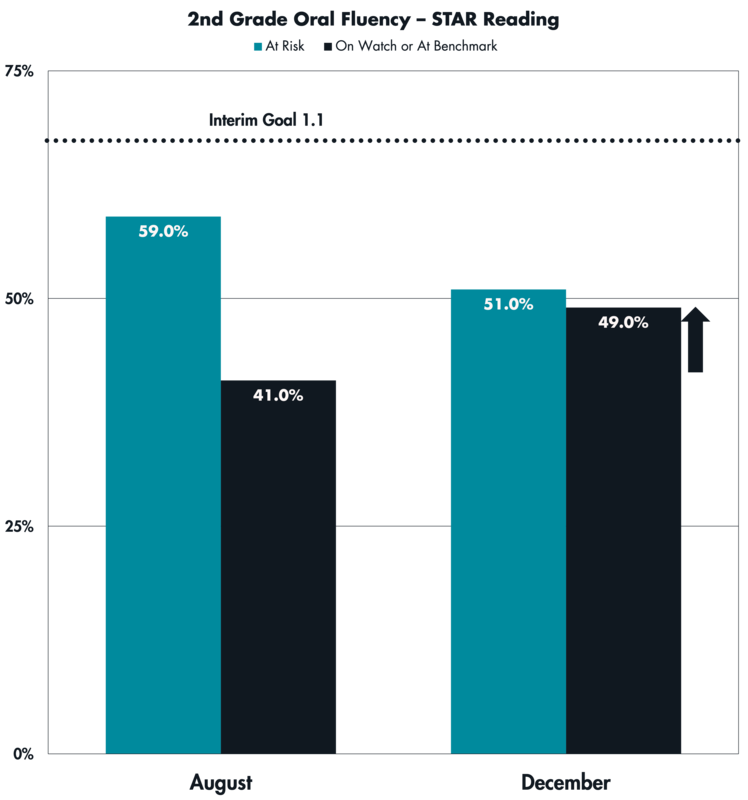
The black arrow indicates our interim goal of increasing proficient students to the black dotted line,
Interim Goal #1.2
The percentage of students performing at Proficiency or Higher on the second-grade STAR Reading Assessment will increase from 28.9% to 35% by May 2026.
This interim goal is on track.
At the start of the school year, second-grade students were performing at 28.3% proficiency on the assessment. At the time of the December benchmark testing, they were performing at 31.5% proficiency, and are expected to achieve 35% proficiency by May 2026.
Interim Goal #1.3
The percentage of students performing at minimally proficient on the second-grade STAR Reading Assessment will decrease from 59.7% to 45% by May 2026.
This interim goal is trending correctly, but off track.
At the start of the school year, second-grade students were performing at 63.4% minimal proficiency on the assessment. At the time of the December benchmark testing, they showed improvement to 60.5% minimal proficiency. While encouraging, they are not currently expected to achieve the 45% goal set for May 2026.
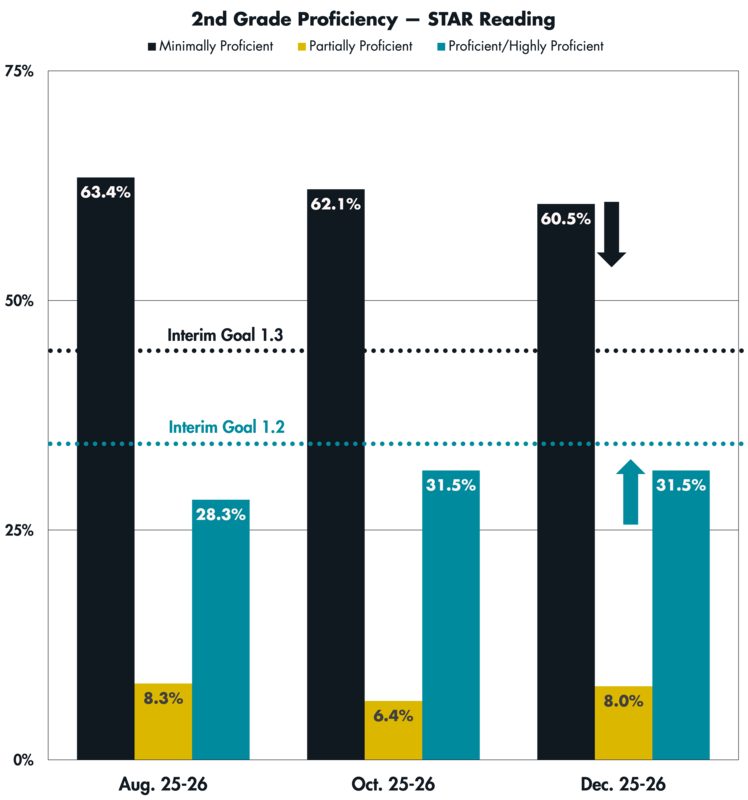
The black arrow indicates our interim goal of reducing minimally proficient students to below the black dotted line, and the teal arrow indicates increasing proficient students to above the teal dotted line.
Input Monitoring
Priority Reading Plans
Bi-Monthly Ashlock Learning Walk Weeks
We have seen 100% participation from site Instructional Coaches and 92% from Principals.
A system has been established to coach both site instructional coaches and teachers on implementing routines.
Round 3 - Next steps for ICs:
Coaches are checking off on additional routines (TC 5-6, and 10 multisyllabic) and lessons (Syllable Types and Divisions) with Elizabeth and Erika by Friday, January 30th.
Coaches will model the Syllable Types lesson and the VCCV Syllable Division lesson for all 2-5 grade teachers/students by Tuesday, March 31st.
Coaches will observe and coach all teachers on their implementation of TC 5-6 and TC 10 multisyllabic by Tuesday, March 31. They will continue to coach on any past routines still in need of support from round 2 of implementation
Our Director of Early Literacy and Early Childhood will work directly with principals to support them in effectively monitoring classrooms and using look-fors aligned with the components of the Priority Reading Plans.
Strategic Look-Fors in District-wide Learning Walk Tool
We have refined our learning walk tool each quarter to capture more specific data on the Priority Reading Plans as implementation strengthens. These are screenshots of the current Q3 look-fors that principals, ICs, and district leadership are assessing during learning walks.
In Q3, we have moved beyond just looking for the foundational structures of the Priority Reading Plans (room setup, door signs, lesson pacing) to include specific strategies and a focus on comprehension.
STAR CBM Progress Monitoring Reports
Within the Renaissance system, we can access reports for each measure, including this one that shows progress against each benchmark and helps evaluate the effectiveness of our interventions.
We have not previously had a district-wide system for monitoring and responding to this data. However, in our work building out a comprehensive MTSS model, we are being intentional about the data we collect, how we collect it, and how we respond. This will include clear protocols and structures for sites to inform interventions.
While schools are using phonics screeners to assess individual students’ phonics skill proficiency, we don’t have a district-wide digital system to collect that data. The Teaching and Learning team is actively working with Renaissance to implement a phonics screener within our platform. Having easy access to this level of data will support more accurate student groupings for intervention.
These are the current CBMs that we administer:
Kinder
RAN Colors 1 min
Receptive Nonsense Words 1 min
Phoneme Segmentation 1 min
1st Grade
RAN Colors 1 min
Expressive Nonsense Words 1 min
Passage Oral Reading (ORF) 1 min
2nd Grade
Passage Oral Reading (ORF) 1 min
3rd Grade
Passage Oral Reading (ORF) 1 min
PLT Protocolos
Weekly PLT observations by T&L Leadership
Our T&L leadership visits site PLT meetings each week, typically on Tuesdays. We use the rubric to measure implementation of the protocol and provide feedback.
Observation Tool
An observation tool was created based on the GEARS rubric from Project Momentum, along with our protocols for the Weekly Planning Meeting and Weekly Data Meeting. Our current average score for PLT observations is 2.1
Weekly collaboration between site and district instructional coaches using the PLT protocols
A member of our Teacher Effectiveness team is partnered up with each of our schools to co-plan and co-facilitate the PLT meetings. This serves multiple purposes: professional learning for both coaches through collaboration; lived experience to inform what additional supports schools may need to implement the protocols effectively; and shared responsibility in the efforts. The district team meets bi-weekly to debrief experiences and determine next steps to strengthen the work.
Monthly IC "PLC" focused on sharing progress and challenges, learning new strategies, and using available resources and tools
Instructional coaches engage virtually in a PLC meeting where they collaboratively share successes, problem-solve, and receive additional professional development on implementing the PLT cycle.
IXL Data Reports
Usage reports from IXL
We are continuing to evolve the guidance we provide regarding the most effective use of IXL within the intervention blocks. Teachers received training on IXL during the summer, and additional sessions have been offered. However, we believe there is more we can do to ensure the time protected for interventions is utilized effectively.
Analysis of IXL usage and student learning data
We are working on plans for a more defined reading intervention program, including the use of SIPPS for students in grades K-5. The goal in IXL is for students to become proficient in at least 1 skill in each subject — in this case, reading — each week.